New book documents rapid changes across the Arctic region
Journalist Neil Shea explores the melting ice, shifting wildlife, and cultural impacts in his latest work, Frostlines.
By Christian Morales ·
Anchorage readers can explore the shifting realities of the high north through a new book by veteran journalist Neil Shea. Titled Frostlines: A Journey Through Entangled Lives and Landscapes in a Warming Arctic, the 240-page volume was published by HarperCollins in 2025. The book is priced at $28 and details the physical and social transformations occurring in the Arctic.
Shea serves as the current Snedden Chair in the Science and Environmental Journalism program at the University of Alaska Fairbanks. He has traveled to the Arctic for more than two decades, observing changes he describes as occurring with startling speed. His work focuses on the entangled lives and landscapes in a warming north, moving beyond simple observation to examine the consequences of rising temperatures.
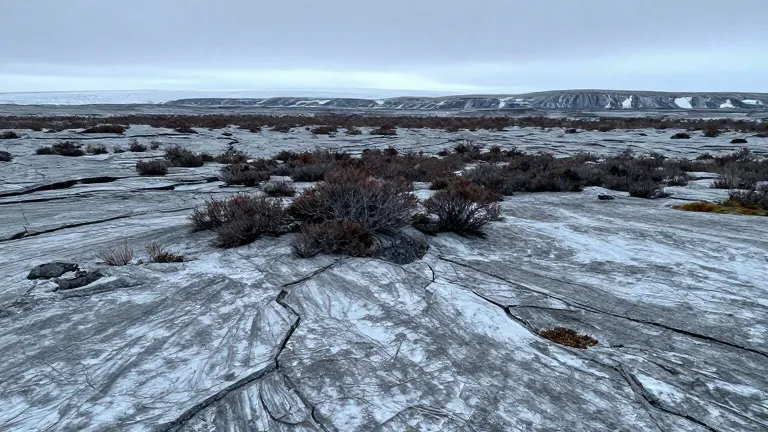
The text opens with a description of the destruction of the Arctic cryosphere, which includes glaciers, sea ice, snow, and permafrost. Shea asks what it means for all of us if the north ceases to be cold. To find answers, he travels from Alaska in the west to Norway in the east. He notes that he was unable to enter Russia due to current political upheaval caused by Vladimir Putin, leaving out the largest Arctic state from his direct visits.
Shea revisits several locations from his earlier career. In Admiralty Inlet, Nunavut, he observes narwhales, which are now prey for killer whales as waters open up. He also returns to the Fosheim Peninsula on Ellesmere Island, where he interacts with white wolves. One specific wolf, a subdominant female with a damaged left eye, becomes a focal point for his descriptions of the region's wildlife.
The book places heavy emphasis on Indigenous communities. Shea spends time in Gjoa Haven, the only settlement on King William Island, immersing himself in Inuit culture. He highlights the loss of subsistence skills that have sustained the people for approximately 1,000 years. Shea writes that the elders’ mortality loomed as the Inuit lost the ice, noting the complex interplay between aging populations and environmental change.
In Canada’s Barren Lands and Alaska’s Anaktuvuk Pass, Shea examines the declining caribou herds. For the Tłı̨chǫ people in Canada, the caribou have dwindled to near the vanishing point, creating an existential crisis. In Alaska, the Nunamiut population at Anaktuvuk faces similar threats. Shea notes that the loss of the herd represents a profound cultural loss, as identity is bound to the animals.
Shea also records the views of Anaktuvuk Mayor Sollie Hugo, who challenges the common nickname of Alaska as the Last Frontier. Hugo argues that Alaska was the passageway for the original inhabitants of the Americas, making it the First Frontier. Shea contrasts this perspective with the historical fate of Norse colonists in Greenland, who arrived around 986 AD and disappeared by the 1400s for reasons still unknown.
The journey concludes at the border between Norway and Russia. Shea describes this area as a fault line in a reemergent Cold War, where a frontier once crossed routinely by Nordic and Russian peoples has closed again. The conflict between Europe and Moscow has brought this tension back to the forefront. Shea’s narrative combines lyrical writing with a focus on wonder and sadness, presenting the Arctic as a place that is no longer an isolated retreat.
Source: Alaska Star · original report published
More News · Anchorage news · Report a business · Got a Story?