Tel Aviv protests clash over coalition with Arab parties
Thousands gathered in Habima Square on Sunday to press for a government that includes Arab-led parties, while counterprotesters vowed to keep Benjamin Netanyahu in power.
By Katherine Brooks ·
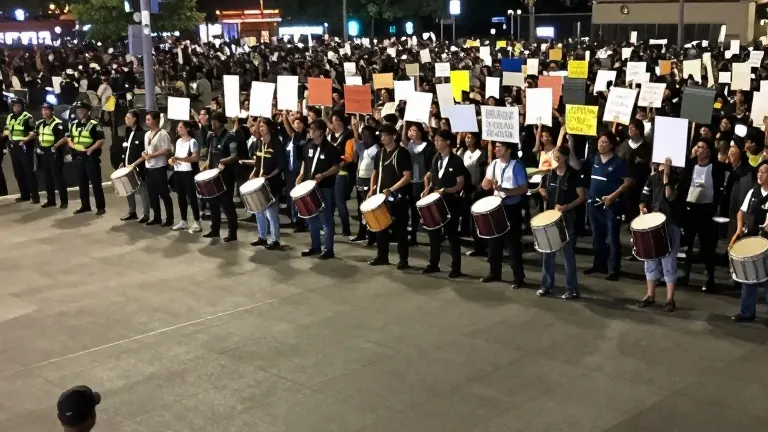
Thousands of Israelis converged on Habima Square in Tel Aviv on Sunday to urge Gadi Eisenkot to build a government that includes Arab parties. The demonstrations occurred four days after the October 27 election, which saw record turnout among Palestinian citizens of Israel. Protesters banged drums and held signs in Hebrew and Arabic that read, “Arabs and Jews will only win together.”
A counterprotest formed in a corner of the plaza, backed by loudspeakers playing rock music and escorted by police. Netanyahu supporters chanted slogans calling for “Bibi the King” and vowed to send “terrorists to Gaza, not the government.” The two groups confronted one another, leading to minor scuffles before police intervened.
The scene in Tel Aviv mirrored the wider political division in Israel. The opposition bloc led by Eisenkot fell 13 seats short of the 61 needed to control the 120-seat Knesset. Eisenkot could reach the prime ministership by allying with the Joint List and Ra’am, which won a combined 19 seats. However, coalition partner Avigdor Liberman, whose party holds seven seats, has ruled out that alliance.
Eisenkot has stated he would accept Arab parties if they recognize Israel as a Jewish state, accept mandatory service, and agree that Hamas must be dismantled in Gaza. The parties have indicated they are willing to support him either by joining his cabinet or by propping up the government from outside. Some Joint List leaders have hesitated to denounce Hamas as a terrorist organization, a condition that could complicate the negotiations.
Martin Kupiec, a professor of genetics at Tel Aviv University, attended the protest with an Israeli flag over his shoulder. He argued that because Arab citizens voted, they should participate in the government. “They are citizens like all other citizens. They went to the polls, so they should be part of the government,” Kupiec said. He noted that for decades, the right wing has maintained that a government cannot be formed with Arabs.
Israeli President Isaac Herzog is set to issue a mandate to either Eisenkot or Netanyahu to form a government. Analysts suggest neither leader can currently amass the 61 seats required. Political consultant Dahlia Scheindlin said that despite fears of a backlash, polling data indicates many anti-Netanyahu voters would accept a partnership with Arab parties. “The opposition’s voters are so desperate to get Netanyahu out that they’re willing to live with one of the options,” Scheindlin said.
Tensions escalated on the streets as left-wing protesters marched toward Rabin Square. A 29-year-old far-right activist, Yonatan Dahman, addressed the crowd, calling opposition demonstrators enemies of their own people. In a widely shared video, Dahman invoked the Holocaust, saying, “You are the first enemies we will send far away, to Birkenau, to Auschwitz.”
A social worker from Haifa, identified only by his surname Paz, was surrounded by Netanyahu supporters who began to shove him. Police escorted him out of the crowd. Paz said the protesters start fights because they hate those who do not see things their way. “They would rather try to start a civil war to stop the formation of the new government,” Paz said.
Two women who accosted Paz argued that the election was stolen. Zehada, a saleswoman from Ramat Gan, claimed there was evidence of voter fraud, including claims that voters wore hijabs to hide their identity. She also asserted that 90 percent of Arab voters do not go to school. “We’re going to burn the streets,” Zehada said if Netanyahu is ousted. Her friend, Dalia Pilova, added, “They’re not going to steal our country.”
The current standoff recalls previous coalitions. In 2021, Naftali Bennett included Ra’am in his government, but the coalition collapsed the following year. In the 1990s, Yitzhak Rabin relied on outside support from Arab parties to pass the Oslo accords. Netanyahu opposed that arrangement at the time, and Rabin was assassinated in 1995. President Herzog will now determine which leader receives the mandate to negotiate.
Source: Alaska Star · original report published
More News · Anchorage news · Report a business · Got a Story?