Europe scrambles jets and evacuates broadcasters after new wave of flight bomb threats
Officials reported threats against 14 flights on Thursday and seven on Tuesday, with the latest alerts forcing diversions across Hungary, France, and the Czech Republic on Friday.
By Christian Morales ·
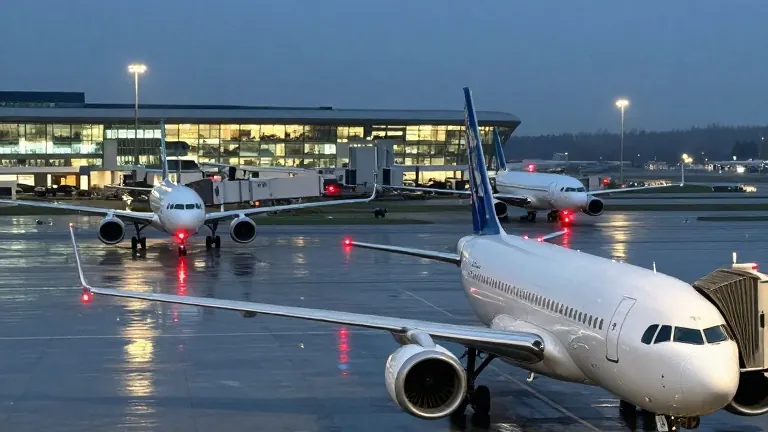
Fighter jets escorted three commercial aircraft through Hungarian airspace on Friday after each plane received a bomb threat.
The military response marked the latest escalation in a series of security incidents affecting European air travel and media infrastructure. Officials confirmed that no suspicious items were found on the planes and no passengers were injured during the events.
The current wave of threats follows a busy week of disruptions for the continent. On Thursday, the European air traffic control authority Eurocontrol identified 14 flights facing bomb threats. That number represented 0.05% of the nearly 26,300 flights operating across the European network that day. On Tuesday, the authority tracked seven such incidents. Earlier in the week, more than two dozen flights were affected by similar alerts, causing some to divert as authorities worked to rule out danger.
On Friday, the alerts spread across multiple countries. French Prime Minister Sébastien Lecornu’s office reported four threats against aircraft flying over France. Those planes landed safely at Paris’ Orly Airport, where bomb disposal experts conducted inspections. In the Czech Republic, spokesperson Denisa Hejtmánková at Prague's Václav Havel Airport said nine flights were targeted. The affected routes included departures to and from Denmark, Spain, Britain, the Netherlands, Cyprus, Romania, and Italy. Czech police stated that security measures had a minimal impact on normal operations at the airport.
Other specific flights faced disruptions. A WizzAir plane traveling from Prague to Rome diverted to Venice after a bomb alert. Passengers evacuated the aircraft once it landed. A Ryanair flight from Lisbon to Rome and a Tarom flight from Prague to Bucharest also received threats. In Denmark, police deployed to Copenhagen airport for a second consecutive day as a precaution. They determined there was no danger to passengers or staff at the facility.
The threats have also reached the broadcasting sector. The Dublin headquarters of national broadcaster RTE was evacuated on Friday due to a bomb threat. Live broadcasts were replaced with prerecorded programs for a few hours. Staff returned to the building after police with sniffer dogs searched the area and declared it safe. Irish Prime Minister Micheál Martin said the incidents illustrate how simple it can be to cause disruption. He noted that a very significant security operation would be in place next week when Dublin hosts meetings of the European Political Community and European Union leaders. Separately, U.K.-based broadcaster Sky reported receiving a security threat but remained on air.
Authorities have not yet attributed the threats to a specific group or state actor. One email sent to airport authorities in Rome on Thursday purported to come from an anti-feminist group targeting a feminist regime. Another European airport received a threat with similar wording, but it is unclear if the same sender was responsible. The incidents occur amid warnings that Russia may be ramping up hybrid threats in Europe.
Robert Jordan, research director at Britain's Royal United Services Institute, told the BBC that secure messaging apps have allowed for greater anonymity in making threats. He said the risk appetite for airlines is incredibly low. Paul Reuter, vice president of the European Cockpit Association, said crews are prepared to respond professionally. He noted that pilots review procedures, identify diversion airports, and may carry extra fuel. Torstein Nymoen, a Norwegian traveler at Prague airport, said the situation is a big problem for aviation and likely costs companies a lot.
Eurocontrol said it is monitoring the situation and working with airlines and airports to mitigate any disruption to air traffic flows. An Garda Síochána, Ireland’s police force, said it is liaising with Irish media organizations to investigate the threat to RTE. It is not yet clear if the incidents at the broadcaster and the flights are linked.