Hawaiian Bird Mechanics: How the 'Akiapōlāʻau Drills for Food
New research reveals that the endangered bird uses a large ankle tendon and full-body force to bore into wood, a method distinct from woodpeckers.
By Nina Patel ·
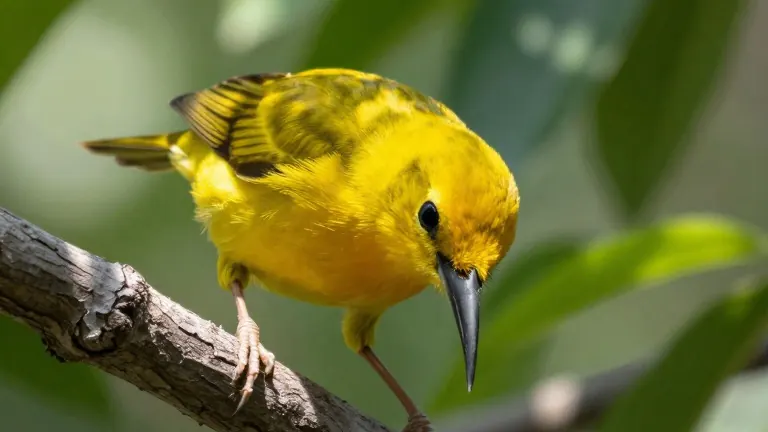
Researchers at the Field Museum of Natural History in Chicago have identified how the endangered 'akiapōlāʻau, a yellow bird native to Hawaii, utilizes its entire body to drill into branches for insects. The study clarifies the mechanical process behind the bird's unique feeding behavior, which involves a bill that functions as two separate tools.
The bird's upper bill is long, narrow, and flexible, allowing it to probe for grubs and caterpillars in crevices. The lower mandible is short and broad, designed to bore into wood. This dual-function beak has been described as looking like bills from two different birds combined. Alexander Clark, a Ph.D. candidate at the University of Chicago and lead author of the study, noted that the species possesses features unseen in any other bird that has ever evolved.
Scientists previously knew the bird drilled for food but lacked an understanding of the anatomical mechanics that allowed it to do so without injury. Clark stated that the research now provides a clear answer to how the bird's body facilitates these movements. The findings indicate that the 'akiapōlāʻau does not rely solely on its beak or neck muscles.
Instead, the bird uses a large tendon in its ankle to drive its whole body downward with force. This action allows the bird to gouge into wood effectively. Clark compared the movement to swinging an axe, explaining that the bird anchors itself to the branch while bending its ankles upward to generate downward momentum. This mechanism differs from that of woodpeckers, which primarily use neck muscles to hammer into wood.
Paul Banko, a co-author of the study and former researcher at the USGS Pacific Island Ecosystems Research Center, suggested that intense competition drove the evolution of these traits. He explained that when the island of Oahu emerged from the water, a large explosion of animal species occurred. These species competed for valuable resources like caterpillars to feed their young, creating pressure for specialized feeding methods.
The 'akiapōlāʻau is found only on the northeastern slope of a single mountain in Hawaii. Experts estimate that fewer than 2,000 individuals remain in the wild, making the understanding of its biological adaptations a key component of its conservation.
The study utilizes data from the Field Museum to map these physical capabilities. It provides a new baseline for how this specific species interacts with its environment to secure food sources in a limited habitat.