Kreiss-Tomkins and Bronson Outline Rural Energy Plans at Fairbanks Conference
Two gubernatorial candidates addressed diesel costs, infrastructure maintenance, and nuclear options at the final panel of the Alaska Rural Energy Conference.
By Christian Morales ·
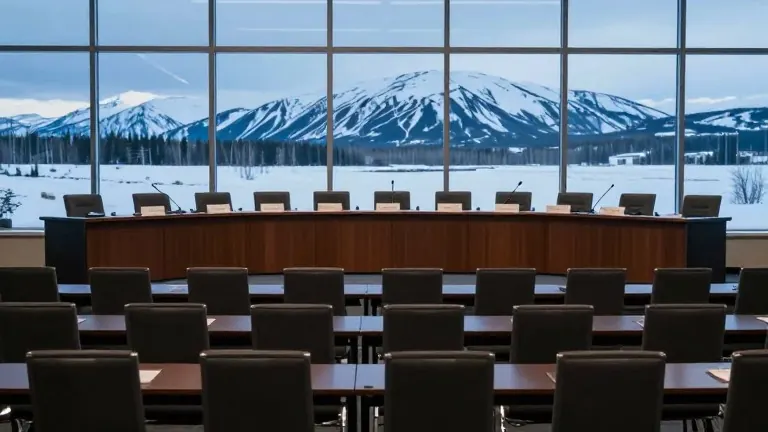
Two candidates for governor outlined their plans to address high energy costs and aging infrastructure in rural Alaska during a panel held in Fairbanks. Democrat Jonathan Kreiss-Tomkins and Republican Dave Bronson, a former Anchorage mayor, answered questions at the final session of the Alaska Rural Energy Conference on Thursday. The other two candidates, Republicans Treg Taylor and Bernadette Wilson, did not attend the event. The conference concluded on Thursday.
Bronson identified diesel as the primary driver of high energy costs in the state. He cited nearly $300 million in deferred maintenance for older diesel generating equipment and approximately $1 billion in deferred maintenance for fuel storage systems. To reduce reliance on expensive barge delivery from the Lower 48, Bronson proposed constructing a 400-mile ice road on the Yukon River. He stated that this route would allow trucks to deliver fuel during the winter months, a method he described as safer and more cost-effective.
Kreiss-Tomkins said the state’s main responsibility is to ensure energy in rural areas is reliable and affordable. He described protecting the Power Cost Equalization program, or PCE, as the most critical step. He stated he would veto any legislative attempt to reduce the PCE endowment. The candidate also supported a statewide energy bond to assist communities in transitioning away from diesel.
Both candidates agreed that PCE should be protected. Bronson suggested the state forward fund the program and secure federal money to support it. He emphasized that PCE should not replace the construction of new generation and fuel storage. Kreiss-Tomkins proposed exploring ways to equalize heating fuel costs in communities where prices reach $15 or $20 per gallon. He noted he prefers the term equalizing over subsidizing but has not finalized his approach.
Regarding infrastructure priorities, Kreiss-Tomkins argued that funding should be based on merit, analysis, and objective need. He said the state needs institutions with technical expertise to assess where the greatest needs lie. He indicated that the Renewable Energy Fund’s prioritization process and the Alaska Energy Authority’s assessments have functioned reasonably well. Bronson said the state should first address villages facing immediate threats of system failure. He noted that some diesel generating facilities are older than the employees who operate them and that many fuel tanks are leaking.
On the topic of nuclear power, Kreiss-Tomkins said he supports nuclear energy but believes small modular reactor technology is not yet proven. He noted that no such reactor has been deployed in Alaska and that the Eielson Air Force Base pilot has been delayed. Bronson disputed this view, stating that most large U.S. Navy capital ships operate on small modular reactors. He asserted that nuclear power is the future of electrical generation in rural Alaska.
A moderator noted that the state spent over $500 million on household weatherization following the 2008 oil price spike, which led to a nearly 25% drop in household energy costs. Both candidates said they would prioritize weatherization efforts now. Bronson called efficiency measures the most immediate way to save on energy costs. Kreiss-Tomkins described weatherization as a real slam dunk.
In response to a closing question about a major idea for making energy affordable, Kreiss-Tomkins described a silver buckshot approach involving multiple policy changes. He listed promoting renewable investment, protecting PCE, and embracing new technologies like plug-in solar. Bronson said he would do what the state is already doing but better in the near term. He specified this includes placing new generator sets where the oldest ones are located and installing larger diesel storage facilities.
Bronson referenced his experience as Anchorage mayor, including overseeing the $2 billion Port of Alaska project. He said he brought in the engineering firm Jacobs to manage that work. He stated that building and managing teams is the most important factor in completing such projects.
Source: KAUU · original report published
More News · Anchorage news · Report a business · Got a Story?