DOT&PF spends $20 million yearly to maintain the 500-mile Dalton Highway
State officials face a $1 billion infrastructure gap and rising freight costs as permafrost thaws and traffic grows.
By Katherine Brooks ·
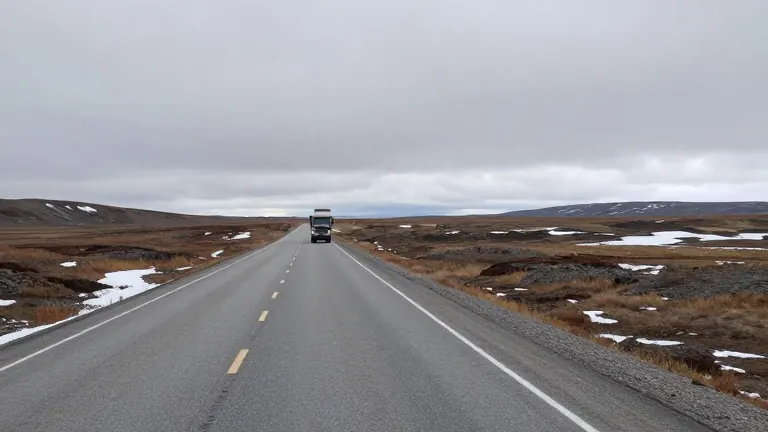
The Alaska Department of Transportation and Public Facilities (DOT&PF) currently spends $20 million a year to maintain the Dalton Highway. Commissioner Ryan Anderson told the Senate Resources Committee in a January 28 presentation that the state has only adjusted this figure for inflation since 2019. The 2019 estimate stood at $16.5 million, with $6 million coming from federal funds. Anderson noted that federal money generally applies to reconstruction and resurfacing projects, not routine maintenance.
The 500-mile road connects the North Slope to the rest of the state and supports national energy production. Traffic is increasing due to the Alaska LNG project and a rise in Arctic tourists. Senator Scott Kawasaki of Fairbanks said the state is not putting enough money into maintenance budgets. He noted that while the total cost of government has remained flat in real terms, the amount of required maintenance has grown.
Road conditions have driven up freight costs. Senator Robert Myers of North Pole, who drives a truck on the highway, said his company has doubled its freight rates over the past few years. Myers attributed the increase to insurance and maintenance costs caused by the road's condition. JR Wilcox, founder and CEO of Alyeschem, said the road is not kind to equipment. His company is building a chemical plant near Deadhorse and recently finished driving its first piles. Wilcox said damage to trucks coming from Fairbanks is a serious concern.
Environmental factors compound the financial strain. Alaska declared three disasters along the highway related to flooding in the past decade. In 2015, ice jams and spring breakup closed the road for nearly a month. Emergency repairs for 24 miles of damage cost $17 million. Last year, flooding damaged the road from mileposts 315 to 404 and forced a five-day closure. Permafrost thawing also threatens the roadbed, a problem monitored by the University of Alaska Fairbanks Geophysical Institute since the early 1980s.
Legislators have struggled to find a long-term funding solution. Kawasaki introduced Senate Bill 286 earlier this year to impose a toll on a two-mile stretch near Deadhorse. The bill stalled due to concerns that toll funds might go into the general fund rather than being earmarked for the highway. Jamie Benson, president and CEO of the Alaska Trucking Association, said the group worries about safety concerns and backlogs. She stated that DOT&PF cannot do its job without appropriate funding.
A 2008 briefing by then-DOT&PF deputy commissioner Frank Richards identified 36 projects needed to support gas pipeline construction. That plan called for $1 billion in improvements, including 24 highway projects. The legislature provided an initial $100 million in 2008, which covered three construction phases. Anderson's recent testimony shows $465.6 million in capital investments in the highway between 2015 and 2025. DOT&PF plans another $454 million in investments through 2031.
The state faces a deficit in most years since 2013, with the exception of 2022. Without higher oil prices or new revenue, balancing the budget requires spending cuts. Anderson said state funding provides flexibility but lacks an automatic mechanism to increase highway funding in proportion to traffic. The department must manage a fleet stretched along a corridor where some sections are 250 miles from the nearest parts store.
Source: Alaska Business · original report published
More Business · Anchorage news · Bad Service · Report a business · Got a Story?