Berlin Returns Stolen Torah Textiles
Two 16th-century ritual items stolen during Kristallnacht were handed to the Berlin Jewish Community on Oct. 22 after residing at a Phoenix synagogue for three decades.
By Christian Morales ·
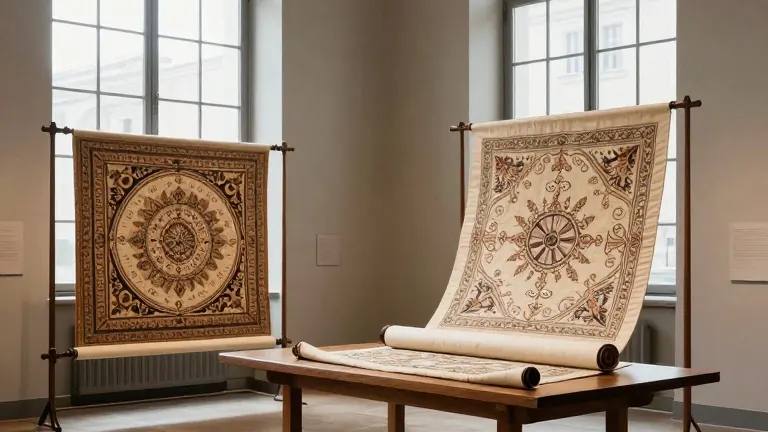
Two Jewish ritual textiles stolen from a Berlin synagogue in 1938 were formally returned to the city’s Jewish leadership on Oct. 22. Associate Rabbi Bonnie Koppell of Temple Chai in Phoenix, Arizona, handed the items to Gideon Joffe, president of the Berlin Jewish Community, at the New Synagogue Berlin Foundation-Centrum Judaicum museum and archive on Oranienburger Strasse.
The objects consist of a Torah wimple and a large parochet, or ark curtain. A University of California, Los Angeles, expert previously determined that both items date to the 16th century. The parochet features embroidery of the Kiddush blessing in Hebrew, along with a signature attributed to an artist from Rivnitz in Moldova. The wimple bears a blessing for a child named Yitzchak, likely created to mark his brit milah.
The items originated from the Fasanenstrasse synagogue, according to the account of the man who sold them. During the November Pogrom, commonly known as Kristallnacht, on Nov. 9, 1938, a German medical doctor named Ahgar claimed he stole the textiles from a burning building. He later approached Moishe Saksenhaus, a Holocaust survivor from Belarus, in a displaced persons camp in Feldafing, Germany. The man demanded Crisco, coffee, flour, cigarettes, and cigars in exchange for the items, threatening to destroy them if Saksenhaus did not comply.
Saksenhaus acquired the textiles and brought them to the United States after emigrating with his wife, Rosa. They remained in the family’s suitcase for years, taken out only for special occasions. Following Saksenhaus’s death in late 1993, his family donated the items to Temple Chai. Rosa Saksenhaus removed a swastika symbol from a tag on the curtain before the donation, stating the object was entering a temple. The congregation displayed the items on its north wall until 2026.
Temple Chai deconsecrated its Phoenix building this spring and moved to a new location in Scottsdale. Before the move, synagogue staff investigated the history of the textiles. Joan Neer, an assistant to Koppell, learned the detailed story of their acquisition from Sol Saksenhaus, the son of the original owner. Neer proposed returning the items to Berlin, a suggestion supported by Koppell and synagogue president Debbie Berkowitz.
The Berlin Jewish Community accepted the offer. Packing and shipping the large parochet proved complicated. The textile was wrapped in artisanal paper and shipped via air freight. Koppell tracked the package using an AirTag and observed it move through Cologne airport. German customs officials requested 5,000 euros in tax and threatened to return the shipment if payment was not received within five days. The Berlin Jewish Community used its tax-exempt status to release the package. Koppell carried the wimple in her hand luggage during the flight.
Twenty-nine visitors from Arizona traveled to Berlin for the handover ceremony. The event included Rabbi Gesa Ederberg and historian Rabbi Andreas Nachama. Nickolai Todorov, a local tour guide who accompanied the U.S. group, described the visit as a moving experience for both the visitors and the historical objects. Koppell told the gathered crowd that the community had come to remember, learn, and return items that had traveled a long distance. She stated that the objects were finally going home.
Experts for the Berlin Jewish Community confirmed that the parochet will be added to the Centrum Judaicum collection. The wimple is planned for display at the community center on the site of the former Fasanenstrasse synagogue. Sol Saksenhaus, who is 72 years old, described the return as a sign of love from his community. He said he can live with the decision, knowing his parents in heaven can live with it too.
Source: The Jewish Exponent